
You will see altitude on almost every coffee bag, including ours. Here is what the number tells you, and what it does not.
Why higher is often different
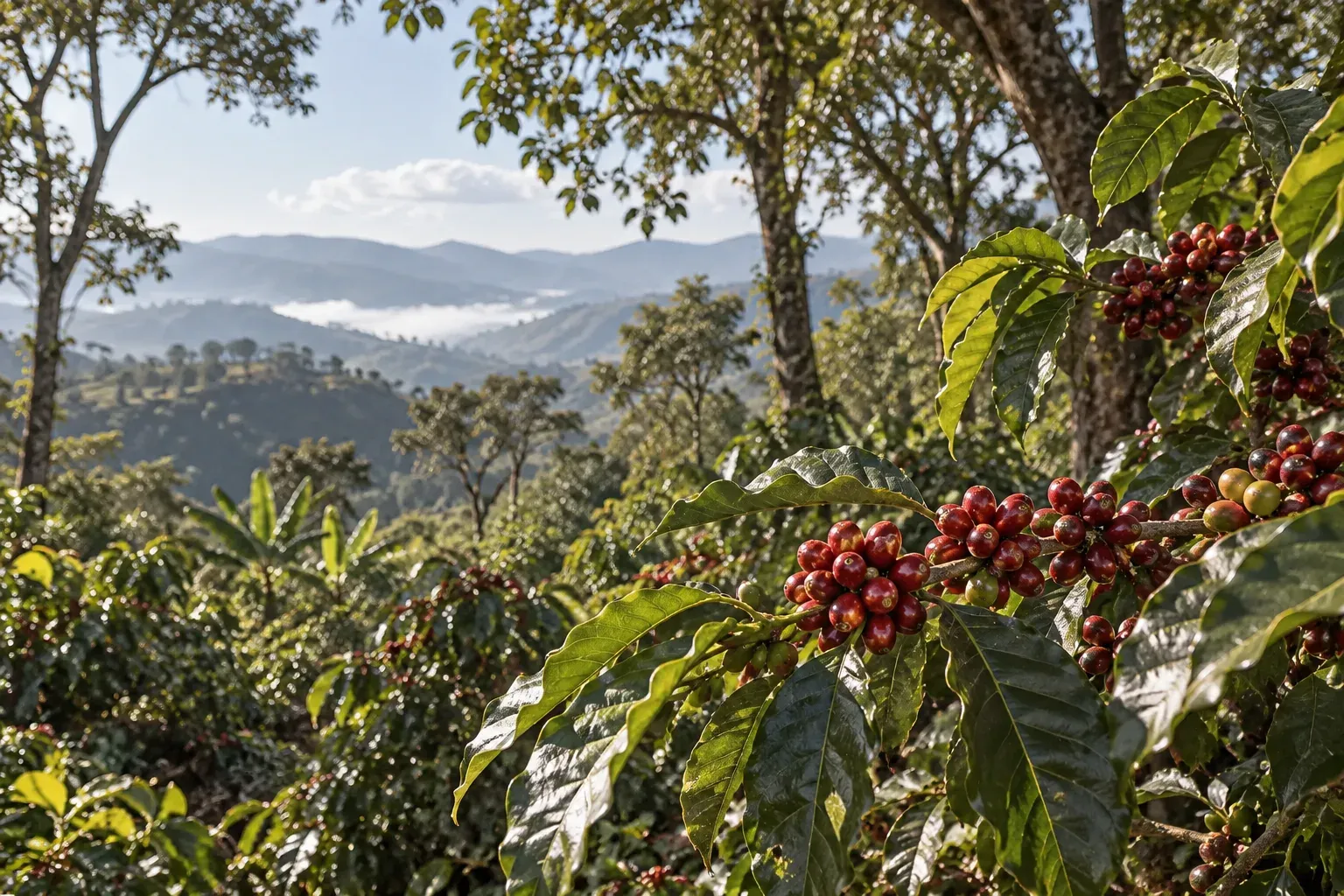
Air gets cooler as you climb, by roughly 0.6 to 0.7°C for every 100 metres. A farm at 2,000 m is several degrees cooler than a farm at 1,000 m in the same area.
Coffee cherries ripen more slowly in cooler weather. A longer ripening gives the plant more time to move sugars and acids into the bean. Growers and buyers often describe the beans as denser and harder, which is why some countries grade coffee by altitude. Guatemala, for example, uses "strictly hard bean" for coffee grown above about 1,400 m.
In the cup, high-grown coffee tends to taste brighter, more complex and often sweeter. Our Gedeb washed lot from Ethiopia grows at 1,900 to 2,200 m, and it tastes of jasmine, lemon and peach. Our Brazilian natural from the Cerrado grows at 1,000 to 1,200 m, and it is nutty, chocolatey and gentle. Neither is better; they are built for different drinks.
Why altitude is not the whole story
- Latitude. Near the equator, high altitudes are needed to get cool temperatures. Farther from the equator, coffee grows at lower altitudes. A farm at 1,000 m in southern Brazil is like a farm at a higher altitude in Colombia. Compare altitude only within the same region.
- Variety. Bourbon, Typica, SL28 and the Ethiopian heirloom varieties all taste different, even at the same altitude.
- Processing. A natural and a washed coffee from the same farm taste very different.
- Soil, shade and rainfall. These affect how the plants grow and how much sugar the cherries hold.
- Harvest and handling. Picking ripe cherries and drying them carefully matter as much as where the trees are.
- Roast. A good roast can bring out or hide any of the above.
How to use the number
Read altitude as a clue, not a score. Here is how we use it when we buy.
- Within one country, higher-grown coffees often have more acidity and fruit. Lower ones are often rounder and softer.
- If you like bright, tea-like coffee, look for high altitudes in Ethiopia, Kenya and Rwanda.
- If you like soft, chocolatey coffee for milk, look at lower altitudes in Brazil or mid altitudes in Guatemala and El Salvador.
- If a bag shows a range, such as 1,700 to 1,950 m, it is a blend of plots across the farm or several farms, not a single point.
A note on what altitude does not guarantee
A high-grown coffee can be badly processed. A low-grown coffee can be excellent. That is why we cup every coffee before we buy it, and why we list the altitude with the variety and the process so you can read the whole picture.
Taste the difference
Pick two coffees on our shelf with different altitudes, brew them the same way and compare. Our cupping class does exactly that with eight coffees at once, and it is a quick way to learn what you like.